
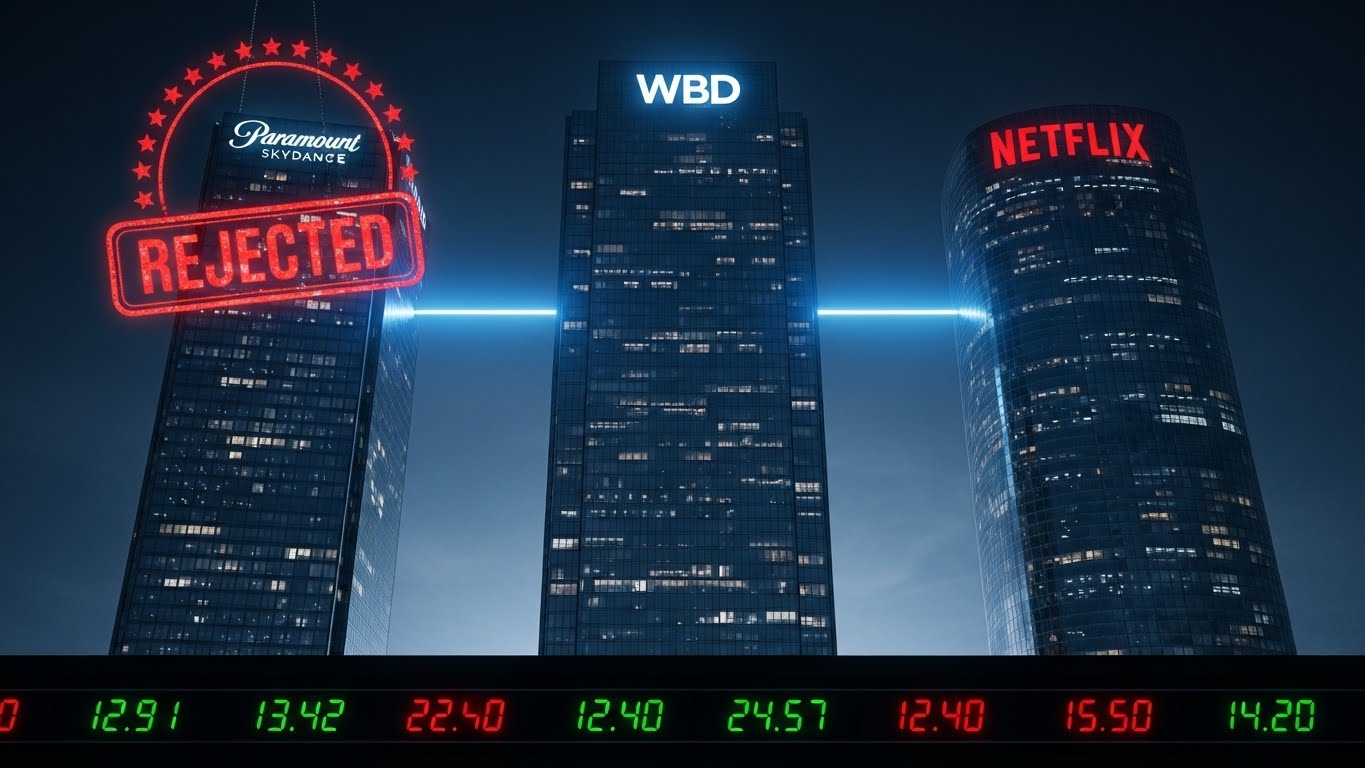
Warner Bros. Discovery has rejected Paramount Skydance’s latest offer to acquire the media giant, maintaining that a competing proposal from Netflix provides superior value and fewer risks for shareholders.
Samuel DiPiazza, Jr., chair of the Warner Bros. Discovery Board of Directors, made the position clear in an official statement. “Paramount’s latest offer remains inferior to our merger agreement with Netflix across multiple key areas,” he declared.
Financial Concerns Drive Rejection
Warner Bros. Discovery emphasized that Netflix’s proposal of $27.75 in cash and stock for WBD’s studios and streaming business delivers superior value without the significant risks embedded in Paramount’s bid. A critical sticking point involves Paramount’s capital structure. The deal contains what WBD described as an “extraordinary amount of debt financing” that would effectively operate as a leveraged buyout, saddling the combined company with $87 billion in gross debt.
The board also raised operational concerns about the extended timeline required to close the Paramount transaction, estimated at 12 to 18 months. This prolonged period would create uncertainty affecting ongoing programming development and sports licensing negotiations, potentially damaging business continuity during a critical period for streaming and content strategy.
By contrast, Netflix operates from a position of financial strength, boasting a market capitalization of $400 billion and providing stability that debt-laden alternatives cannot match.
Sweeteners Still Not Sweet Enough
Following WBD’s initial rejection, Paramount attempted to strengthen its offer by adding a personal guarantee from billionaire Larry Ellison, father of Paramount CEO David Ellison. The guarantee covers $40.4 billion of equity financing, addressing some concerns about deal certainty. However, even this substantial commitment failed to sway the Warner Bros. Discovery board.
The Cable Network Complication
Richard Greenfield, media analyst at Lightshed Partners, identified a crucial element shaping WBD’s decision-making: the strategic value the board places on its cable television networks, previously slated for spinoff under the name Discovery Global.
The Paramount offer includes cable TV networks in the transaction structure, while Netflix’s bid specifically excludes them. This distinction proves decisive given WBD’s corporate strategy.
“It is crystal clear that the WBD Board sees tremendous value in splitting the company up as soon as possible,” Greenfield noted. “Taking the Paramount offer would force WBD to abandon its plans to split the company.”
The analyst believes the board views Discovery Global as worth substantially more as an independent entity or through sale to another buyer than as part of a combined Paramount-WBD structure. “We firmly believe Discovery Global is for sale,” Greenfield stated. “Bidders have already approached WBD as part of its strategic review process.”
What Paramount Would Need to Do
For Paramount to have any chance of reversing WBD’s position, Greenfield outlined steep requirements. “Paramount not only needs to raise its bid substantially above $30 per share, one or two dollars incremental is likely irrelevant. It also needs to change the composition of its bid to absorb the billions of costs associated with abandoning the Netflix bid and shift the financing from mostly debt to mostly cash.”
Such a restructured offer would require Paramount Skydance to fundamentally reimagine its acquisition financing, moving away from the leveraged buyout model that currently defines the proposal. Given the capital-intensive nature of media assets and the limited pool of investors willing to commit tens of billions in equity, such a transformation presents formidable challenges.
Strategic Implications
Warner Bros. Discovery’s repeated rejection of Paramount’s advances clarifies the company’s strategic priorities. The board appears committed to a path that maintains financial flexibility, preserves the option to monetize cable assets separately, and partners with the streaming leader rather than absorbing a debt-heavy competitor.
For Paramount, the rebuff represents a significant setback in efforts to achieve scale through acquisition. The company must now either dramatically restructure its offer in ways that may prove financially unfeasible or pursue alternative strategies for competing in an increasingly consolidated media landscape.
The Netflix deal, meanwhile, positions Warner Bros. Discovery to focus on streaming and studio operations while potentially unlocking value from legacy cable assets through spinoff or sale. This path aligns with broader industry trends as traditional media companies navigate the transition from linear television to digital distribution.